


When A Rest Position Doesn't Feel Very Restful

In Pilates, we often simply call it a Rest position. In Yoga, you’ll probably know it as Child’s Pose. Which sounds lovely.
Unless, of course, you’re the person thinking Rest? My ankles are killing me.
Or your bottom is nowhere near your heels.
Or your knees aren’t particularly impressed by the whole arrangement.
We often use this position as somewhere to pause between movements, and in Yoga you’ll frequently hear teachers say, 'You can always come into Child’s Pose if you need a rest.'
But here’s the thing: for some of us, it simply isn’t restful. And there’s nothing particularly unusual about that.
Although it looks simple, the position actually asks quite a lot of the body. The knees bend deeply, the hips move back towards the heels, the tops of the feet rest against the floor and the back folds forwards.
If one of those things doesn’t feel comfortable in your body, trying harder to make yourself look like the person on the next mat probably isn’t going to help.
Listening to what your body needs might.
If it’s your ankles, having the tops of the feet against the floor can feel surprisingly intense. Rather than enduring it, try placing a folded blanket underneath the ankles or allowing the feet to sit in a position that feels more comfortable.
That small change can completely alter the experience.
And it tells you something useful too. If this position is difficult for your feet or ankles, it can give you a useful clue as to why a deeper kneeling Yoga pose such as Saddle might also feel uncomfortable. You might assume it’s the backbend you struggle with when actually your feet and ankles were asking for attention long before you got that far.

That’s the sort of information I love discovering in movement. Not because we need to analyse every little thing our bodies do, but because sometimes understanding why something feels difficult takes away that sense that we simply 'can’t do it'.
If it’s your knees, don’t assume they have to be in one particular position. Taking the knees further apart can create more room for the hips and body to move back and may feel much more comfortable. For someone else, having them closer together feels better.
And if deeply bending the knees itself is uncomfortable, we don’t have to keep pushing the hips towards the heels simply because that’s what the position is supposed to look like. Adding some support between the thighs and lower legs, or choosing another resting position altogether, may make far more sense.
If your bottom won’t go anywhere near your heels, let it be where it is. This is one I think people can become unnecessarily concerned about. We see someone else folded neatly back onto their heels and assume that’s where we ought to be too.
But bodies have different proportions and different amounts of movement available through the ankles, knees, hips and back. All of those things contribute to the shape.
Rather than forcing the gap to disappear, we can work with it.
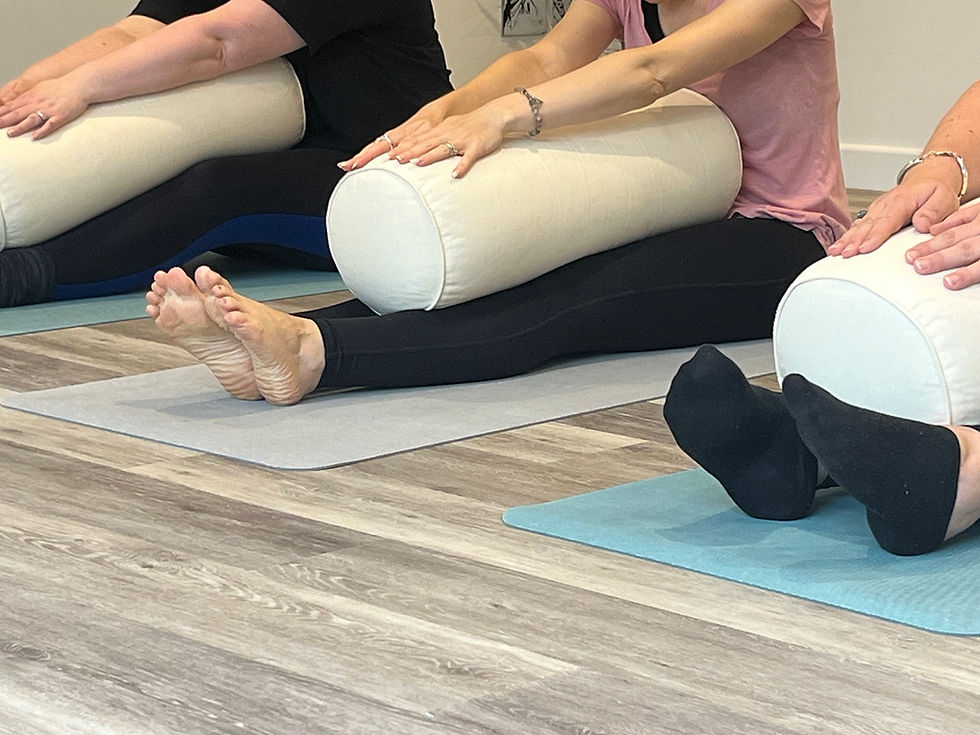
A bolster or other support underneath the body may make the position much more comfortable. Changing the width of the knees can alter the feeling completely. Sometimes simply not trying quite so hard to get somewhere makes the position more useful.
We can notice similar things in Pilates. You might feel perfectly comfortable in four-point kneeling but discover that moving your weight backwards towards your heels changes everything.
Again, that’s not a failure to do the movement. It’s information we can use.
The shape isn’t the test. The shape gives you information, and you’re allowed to respond to it - you don’t have to wait for someone else to tell you it’s okay to change something.
And perhaps that’s where this simple rest position becomes much more interesting.
Instead of asking:
Am I doing this properly?
we can ask:
What does my body need here?
Move the knees. Add a blanket. Use a bolster. Change the position of the feet. Don’t travel quite so far back. Or choose a completely different position when you need to rest.
None of those is a lesser version.
They’re simply ways of accommodating what your body needs that day.
The aim isn’t to force the body into the shape, but to find the version of the shape that works with the body. And that’s an important distinction, because movement doesn’t have to be about squeezing every body into the same position.
Sometimes the most useful thing a position can teach us is not how far we can go, but what happens when we listen, change something, and suddenly think:
Oh. That feels so much better.
And that, to me, is much more useful than getting your bottom to your
heels.


Comments